
Fire Door Surveys & Inspections
We inspect fire doors across residential buildings, schools, hospitals and commercial properties, assessing each door assembly against its required fire performance and condition.
You receive a clear, door-by-door record of our findings, identifying defects and areas requiring maintenance and helping distinguish between doors that can be repaired and those that may require replacement.
Fire Door Surveys & Inspections
We inspect fire doors across residential buildings, schools, hospitals and commercial properties, assessing each door assembly against its required fire performance and condition.
You receive a clear, door-by-door record of our findings, identifying defects and areas requiring maintenance and helping distinguish between doors that can be repaired and those that may require replacement.





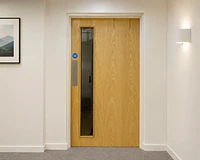
What is a fire door survey?
A fire door survey checks whether each door is capable of containing fire and smoke for the period it was designed to achieve, and whether it remains compliant with the relevant fire safety requirements and guidance.
We inspect the door leaf, frame, hinges, seals, glazing, closing device and the gaps around the door.
You receive a door-by-door record of the condition of each door, supported by clear photographs. Faults are separated into those that can be repaired and those where replacement is the more suitable option, helping you prioritise work and avoid unnecessary costs.
How a survey helps you meet the regulations
For most buildings, checking fire doors is no longer just good practice, it is a specific legal requirement.
Under the Fire Safety (England) Regulations 2022, the Responsible Person for a multi-occupied residential building above 11 metres must carry out quarterly checks of communal fire doors and annual checks of flat entrance doors, on a best-endeavours basis.
The Fire Safety Act 2021 also clarified that flat entrance doors in multi-occupied residential buildings fall within the scope of the Fire Safety Order.
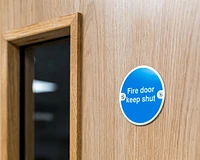
A fire door checked once is not a fire door maintained
Fire doors only protect a building when they are inspected and kept in working order over time.
A fire door passed last year is not a fire door passing today. Hinges loosen, gaps widen and seals get painted over, often through nothing more than daily use. Staying compliant means regular, recorded inspection, not one check and the matter closed.
Read about ongoing checksHow Often Do Your Fire Doors Need Checking?
Fire doors need to be checked throughout their working life, particularly where regular use, damage or alterations may affect how they close and perform.
For residential buildings above 11 metres, the Fire Safety (England) Regulations 2022 require quarterly checks of fire doors in common areas and annual checks of flat entrance doors. A detailed door survey supports this ongoing programme by recording the condition of each assembly and identifying where repair, adjustment or replacement is required.
The duty falls to the Responsible Person for the building, which is usually the building owner, managing agent or whoever has control of the premises. We carry out surveys for owners, managing agents, housing associations and facilities managers to help them meet that duty.
Not necessarily. A door that was correct when the building was built can often continue to provide adequate protection if it is undamaged and in good working order. A survey identifies the doors that genuinely need work, rather than recommending wholesale replacement.
Want to discuss your fire door survey?
Speak to our expert fire protection team.
Related articles
Who Is the ‘Responsible Person’ – and Why It Matters More Than You Think
Fire safety in buildings isn’t just about the systems, inspections, or compliance certificates—it ultimately comes down to one key role: the Responsible Person.
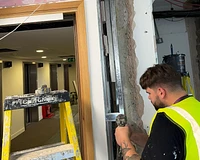
Fire Risk Assessments, Compartmentation & Fire Stopping: A Practical Guide for Property Managers
If you manage residential or mixed-use buildings, chances are you’ve recently had (or been advised to have) a Fire Risk Assessment (FRA) carried out.
.webp)
Signs Your Building’s Fire Stopping May Be Compromised
Fire stopping plays a vital role in passive fire protection, sealing gaps and service penetrations to maintain compartmentation. But even high-quality fire stopping can be compromised over time, and often, the signs aren’t obvious until it’s too late.