
Fire collar installation
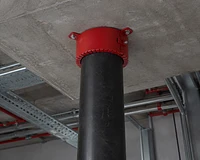
Fire collars are installed around plastic pipes where they pass through fire-rated walls and floors.
When exposed to heat, the material within the collar expands as the pipe softens, closing the opening and helping prevent fire and smoke from spreading into the adjoining compartment.
Each collar is selected to suit the pipe, wall or floor construction and required fire rating, then installed to the manufacturer’s tested instrcutions and recorded for your building’s fire safety information.
Certified Fire Collar Installation
Our trained operatives install fire collars in accordance with the requirements of the tested system, ensuring the correct product and installation detail are used for the specific pipe and construction.
Qualifying installations are covered by our BlueSky third-party certification. FIA membership, together with CHAS and SSIP credentials, supports the technical standards and site controls applied throughout the installation process.





What is fire collar installation?
Fire collars are fitted around plastic pipes where they pass through fire-rated walls and floors.
When exposed to heat, the material inside the collar expands and closes the opening left as the pipe softens, helping to stop fire and smoke spreading into the next compartment.
We install fire collars in apartment blocks, offices, healthcare premises and industrial buildings. Each collar is selected to suit the pipe, wall or floor construction and required fire rating, then fitted in line with the manufacturer’s tested installation detail.
Working around your building
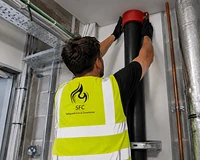
Fire collars are not limited to new-build projects.
We regularly install them as part of remedial works in occupied and existing buildings where plastic pipework passes through fire-resisting walls and floors without suitable protection.
Where appropriate, retrofit fire collars can be installed around existing pipework and fixed to the surrounding wall or floor construction, avoiding the need to disconnect or alter the pipe itself. Each installation is assessed and carried out in accordance with the requirements of the relevant manufacturers tested system.
Fitted to the tested detail
A fire collar only performs if it is the correct product for the situation and installed correctly.
Before installation, we check the pipe type, pipe diameter, wall or floor construction and the required fire performance. A collar suitable for a masonry wall is not automatically suitable for plasterboard, and a small waste pipe requires a different solution from a larger soil pipe.
Each collar we install is recorded as part of the building’s firestopping documentation, including its location and the system used. This provides a clear record of the completed installation for future reference and building fire safety records.
Why The Tested Installation Detail Matters
A fire collar’s performance depends on more than the product itself. It must be suitable for the pipe, the surrounding wall or floor and the level of fire protection required.
Fire collars are tested and classified under BS EN 1366-3 and BS EN 13501-2. The stated performance relies on the collar being selected, positioned and fixed in line with that tested detail, so recording the product and installation is an important part of showing that the correct protection is in place.
Yes. Retrofit collars are fitted around the existing pipe and fixed to the wall or floor, so in most cases there is no need to disconnect or replace the pipework. This makes retrofitting an effective way to correct missing or inadequate protection in buildings already in use.
Metal pipes behave differently from plastic in a fire and usually call for a different fire stopping solution, such as a fire-rated wrap or sealant, rather than a fire collar. We assess each penetration and use the correct tested system for the pipe and the construction.
Want to discuss your fire collars?
Speak to our expert fire protection team.
Related articles
Common Fire Stopping Mistakes and How to Avoid Them
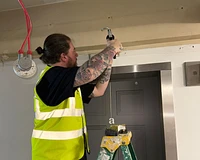
Fire stopping is an essential part of any building’s passive fire protection strategy. When installed correctly, it helps contain fire and smoke within designated compartments, giving occupants time to evacuate safely and protecting the structure. But fire stopping can often be installed incorrectly or is neglected over time.
.webp)
Signs Your Building’s Fire Stopping May Be Compromised
Fire stopping plays a vital role in passive fire protection, sealing gaps and service penetrations to maintain compartmentation. But even high-quality fire stopping can be compromised over time, and often, the signs aren’t obvious until it’s too late.

New Buildings Aren’t Always Compliant: Why Fire Stopping and Compartmentation Still Fail
There’s a common assumption in the construction and property industry that new buildings are automatically compliant when it comes to fire safety.