
High-rise fire protection specialists
Much of the fire protection and external wall work required on taller buildings is in areas that are difficult to reach safely.
Façades, cladding, rooflines, high-level junctions, external wall cavities and upper-level voids all require suitable access for inspection, opening-up and remediation. We plan the access requirements alongside the fire protection works, helping keep projects safe, efficient and well controlled.
Accredited Specialists Working at Height
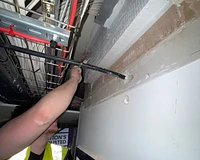
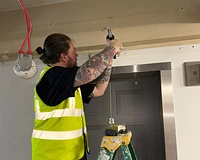
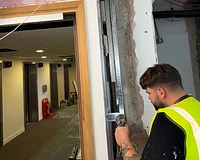
Passive fire protection work is often required above ceilings, within high-level service routes and in other areas where specialist access equipment is needed.
Our IPAF-trained operatives can use powered access equipment to reach elevated and difficult-to-access areas safely. This is supported by our CHAS and SSIP credentials for health and safety management, alongside BlueSky certification and FIA membership supporting the technical standards behind our passive fire protection work.




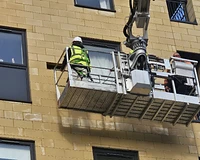
Safe working at height
There is no single access solution for every building.
We assess the height, ground conditions, available space, access restrictions and nature of the work before selecting the most appropriate equipment. We then organise the equipment and plan the logistics.
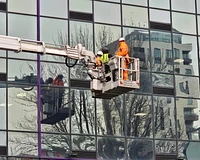
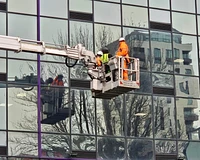
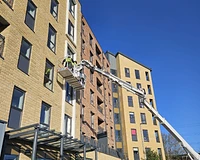
Our IPAF-trained operatives can use a range of powered access equipment, including truck-mounted platforms and tracked spider lifts, alongside mobile towers and scaffolding where appropriate. Health and safety is central to how we plan and deliver work at height. We consider access routes, ground conditions, exclusion zones, residents and occupiers, public safety and the sequencing of the works before equipment arrives on site.
The right access for the job
The access method is selected to suit the building and the work required, rather than using a one-size-fits-all approach.
Truck-mounted platforms can provide efficient access to façades and high-level areas where suitable hardstanding is available. Compact spider lifts can be useful for restricted access, courtyards, podiums and confined spaces, while mobile towers can provide practical access for lower-level or contained works.
Scaffolding may be appropriate where extensive works are required across a large area or access needs to remain in place for longer. We consider all available options and select the safest and most practical solution for the project.
Our combination of specialist fire protection knowledge, IPAF capability and careful access planning allows us to reach difficult areas safely while keeping disruption to residents, businesses and other building users to a minimum.

Safety standards, recognised under SSIP
Working at height leaves no room for cutting corners on safety.
SSIP accreditation is independent confirmation that health and safety management meets a recognised standard. It sets out what that assessment involves and why it matters at height.
Read the announcementWe use a range of specialist access equipment, matched to each job. For most external work we coordinate truck-mounted cherry pickers, in various sizes, through a trusted local provider, and we organise all of the planning ourselves. We also use scaffold towers, which are typically put up and taken down the same day, and specialist tracked platforms known as spiders for areas with tight or restricted access.
Yes. We assess what each job needs, organise the right equipment and handle all the coordination and logistics, so you do not have to manage a separate access contractor alongside the fire or external wall work. It is all arranged and run by one team.
We do yes- most buildings we work on are occupied. Our teams work efficiently to pre-planned schedules to ensure all work is carried out efficiently and with minimal disruption.
Our full range of services
Want to discuss a fire protection project?
Speak to our expert team.
Related articles
.webp)
Signs Your Building’s Fire Stopping May Be Compromised
Fire stopping plays a vital role in passive fire protection, sealing gaps and service penetrations to maintain compartmentation. But even high-quality fire stopping can be compromised over time, and often, the signs aren’t obvious until it’s too late.
New Buildings Aren’t Always Compliant: Why Fire Stopping and Compartmentation Still Fail
There’s a common assumption in the construction and property industry that new buildings are automatically compliant when it comes to fire safety.